About Urfi javed
In a world where celebrities often play it safe, Urfi Javed stands out as a storm of creativity, courage, and unapologetic self-expression. Whether you love her or criticize her, there’s no denying one thing — Urfi has redefined what it means to own your individuality.
She was born on October 15, 1997, in Lucknow, Uttar Pradesh, Urfi’s journey to fame is as dramatic as her wardrobe choices. After completing her degree in Mass Communication from Amity University, she set her sights on television — and soon found herself acting in shows like Bade Bhaiyya Ki Dulhania, Chandra Nandini, and Meri Durga. But the real turning point came in 2021, when she entered the reality show Bigg Boss OTT. Overnight, she became a household name — and a social media phenomenon.
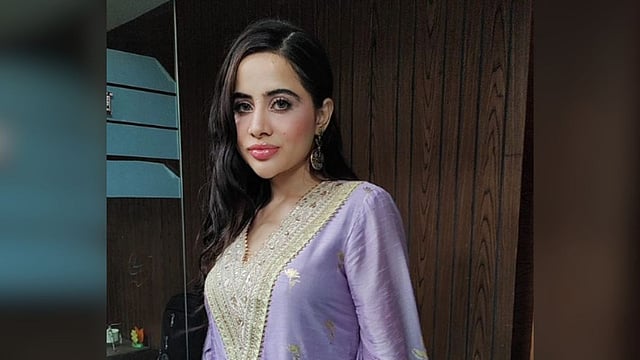
Table of Contents
THE GIRL WHO TURNED FASHION INTO ART
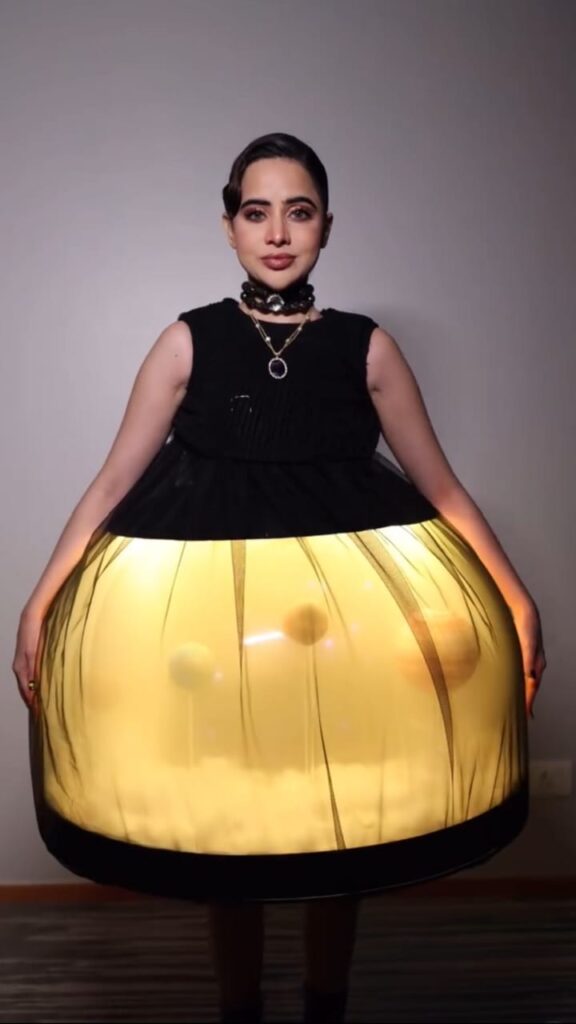
If there’s one thing that defines Urfi Javed, it’s her fearless fashion. From dresses made of safety pins, flowers, watches, and even X-ray films, Urfi treats clothing as a form of artistic rebellion. Each outfit tells a story — not just of boldness, but of creativity and confidence.
She often says she designs many of her looks herself — proving that fashion doesn’t need to be expensive to be expressive. For Urfi, the body is a canvas, and style is the paint.
Of course, her unconventional looks often stir controversy. But Urfi doesn’t just shrug off the criticism — she embraces it. In her words:
The Rise of Urfi Javed: From Small-Town Girl to Bold Fashion Icon
In today’s world of quick fame and viral moments, few have managed to turn controversy into career quite like Urfi Javed. Her story is not just about clothes or social media buzz — it’s about fearlessness, resilience, and self-expression in a society that often tries to silence unconventional women.
She is bold, unfiltered, and unapologetically herself — a girl from Lucknow who transformed into one of India’s most talked-about style icons. Her journey from rejection to recognition is not just inspiring — it’s revolutionary.

THE RISE: FROM TV STRUGGLES TO BIGG BOSS OTT SUCCESS
~Carrer in television~
Urfi’s career began in 2016 when she appeared in the TV serial “Bade Bhaiyya Ki Dulhania” as Avni Pant.
She went on to act in several daily soaps, such as:
- Meri Durga
- Bepannaah
- Chandra Nandini
- Kasautii Zindagii Kay (season 2)
~Bigg Boss OTT~
In 2021, Urfi entered Bigg Boss OTT, a reality show streamed on Voot. Though her stay was short, her confidence, wit, and unique fashion sense made her stand out immediately.
She didn’t win the show — but she won attention. Millions started following her on Instagram overnight.
Why She Became Famous
Urfi Javed became famous primarily because of her bold fashion choices, fearless attitude, and skillful use of social media. Originally known as a television actress, she truly rose to national attention when she began experimenting with unconventional outfits made from everyday materials like wires, glass pieces, safety pins, or recycled items. These unique and often controversial looks set her apart in a society where women are still judged for self-expression and bold clothing. Her outfits quickly went viral online, drawing both admiration and criticism, but the attention only helped her gain more visibility.
In the age of digital media, Urfi understood the psychology of fame — that controversy often drives engagement. Every time she stepped out in an unusual outfit or shared a daring photoshoot, social media erupted with reactions, memes, and debates. She used this constant attention to build a personal brand centered around confidence and individuality. Even when traditional media criticized her, it kept her in the headlines, proving the old saying that “no publicity is bad publicity.”
Beyond her fashion, Urfi’s outspoken personality also contributed to her fame. She often addresses online trolling and calls out double standards, especially those targeting women in the entertainment industry.

The downfall of Urfi javed: When boldness turns into backlash
1-Reputation & Industry Push-back
A major complaint: in a public-interview she revealed that a casting director told her she “won’t get work in television” because her “image is so bad”.
Her bold fashion choices and public persona, which contributed to her rise, have also led to complaints of “obscenity” and “illegal/indecent acts” in public/online forums.
2- Legal & Controversy Burden
She was booked in a criminal case for allegedly staging a “fake arrest” video with the Mumbai Police emblem/uniform being mis-used, leading to sections under the IPC being applied.
A written complaint was filed against her in 2022 for allegedly committing “illegal and obscene acts” in public/social media.
3-Polarised Public Perception
Her outspoken views (e.g., leaving her faith, rejecting traditional expectations) and her unique fashion attracted wide attention but also strong backlash.
Feedback from critics: for example, writer Chetan Bhagat reportedly called her “a distraction for youth” because of social media consumption.
A polarised image risks limiting appeal among certain audiences (brands, mainstream films/TV) who prioritise “safe” reputations.
4-Over-Exposure of the Shock Element
Part of her brand is shocking / unconventional fashion and behaviour. But once the “shock” becomes expected, it can diminish novelty, and the brand may struggle to evolve.
For instance, critics argue her controversies are being seen as “for publicity” (e.g., the fake-arrest video described as a “marketing strategy”).
Relying heavily on controversy and spectacle can be unstable — if audience interest shifts or brands get more cautious, momentum can fade.
5-Business/Opportunities Setbacks
Reports indicate she faced business failure and rejections, such as missing a red-carpet opportunity at an international festival because of visa refusal, and noting “my business didn’t work… tried different things only to face rejections.”
Opportunity cost: as mainstream roles or brand deals become harder, the channel of income/fame may narrow.
“From Trolling to Trendsetting: The Social Psychology of Urfi Javed’s Fame”
1-The Psychology of Self-Expression and Identity
At the psychological level, Urfi Javed represents a powerful case of self-actualization and identity assertion. Through her distinctive clothing and unapologetic personality, she challenges traditional norms of femininity and morality. This can be seen as an act of individuation — the process of forming a unique identity that resists social conformity.
Urfi’s behavior may also reflect a need for autonomy and validation. In the digital era, where visibility often translates to influence, her boldness becomes a form of empowerment. She controls her narrative by turning what others see as “controversial” into a statement of freedom.
2-Social Perception and the Role of Media
From a sociological viewpoint, Urfi’s public reception exposes the double standards and gender biases in Indian society. Male celebrities often enjoy leniency for eccentricity, whereas women who defy norms face moral policing. Urfi’s media portrayal — oscillating between mockery and admiration — mirrors the ongoing cultural conflict between tradition and modernity.
Social media further amplifies this divide. The internet rewards attention, not subtlety. Urfi, consciously or not, plays into this psychology of visibility — using outrage as a tool for relevance, challenging viewers to question why her choices evoke such strong reactions.
3-The Psychology of the Audience
the public’s reaction to Urfi also reveals much about collective psychology. The criticism she faces often stems from projection — where people displace their own insecurities or moral anxieties onto a visible figure. For others, she represents liberation — someone daring to do what many secretly wish they could: live without fear of judgment.

“The Redemption Arc of Urfi Javed: From Trolled to Triumphant”
Once dismissed as a social-media spectacle, Urfi Javed has quietly rewritten her own story — turning ridicule into recognition and criticism into creative power. Her journey is a testament to resilience in a world quick to judge and slow to understand. From being trolled for her bold fashion choices to being celebrated for her unapologetic individuality, Urfi has transformed public perception through sheer authenticity and self-belief. What once made her a target of memes is now what defines her as a fearless trendsetter.
She has shifted the narrative from controversy to conversation, proving that personal expression and confidence can outshine even the harshest criticism. Urfi’s redemption arc isn’t about conforming to expectations — it’s about redefining them, and in doing so, she has emerged as a symbol of empowerment, creativity, and self-acceptance in the Indian entertainment space.
“Her Ethical and Cultural Decision: A Stand for Self and Society”
Urfi Javed’s journey isn’t just about fashion; it’s about making a statement rooted in deep ethical and cultural reflection. In a society where women’s choices are often dictated by conservative traditions and moral expectations, Urfi’s decision to express herself freely challenges long-held cultural boundaries. Her bold outfits and unapologetic persona have sparked debates — not just about style, but about the ethics of personal freedom versus societal conformity.
Urfi, dressing the way she wants isn’t rebellion for attention; it’s an ethical stand for individuality, agency, and self-respect. She questions the idea that culture must limit expression, showing instead that culture evolves when individuals have the courage to redefine it. Through her choices, Urfi embodies the modern woman’s dilemma — and triumph — of staying true to herself while standing tall in a world that often confuses authenticity with defiance.

“The Final Chapter: What Urfi Javed’s Journey Teaches Us”
Urfi Javed’s journey from fame to downfall is a complex reflection of the modern celebrity culture — where admiration and criticism walk hand in hand. Once celebrated for her boldness and individuality, Urfi became a victim of the same spotlight that once lifted her. Her story reminds us that fame is fleeting, and public opinion can shift in an instant. Yet, beyond the controversies and judgments, Urfi’s courage to be unapologetically herself stands out. Whether one agrees with her choices or not, she forced society to confront its double standards — about freedom, culture, and women’s expression. Her rise and fall are not just about fame; they are about the price one pays for authenticity in a world that often fears it.
———–x————–xTHANKYOU———-X————-X